
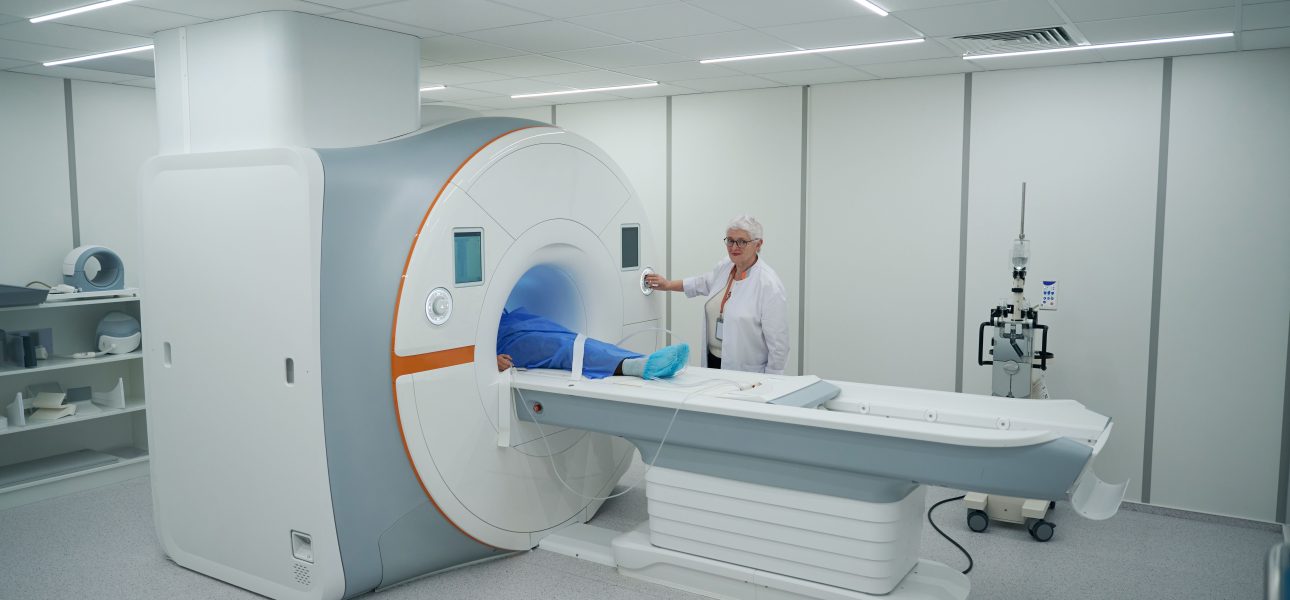
Imaging suites fail in two specific ways that no other room in a healthcare project does. They fail when the magnet picks up interference and produces unreadable scans, and they fail when a regulator measures radiation outside the suite and stops the project from going live. Both failures trace back to the same root cause: shielding that was specified late, designed loosely, or installed without coordination. By the time a magnet is moved into a vault, decisions made eighteen months earlier in design development determine whether the suite will scan cleanly or whether the project will face costly remediation.
This article walks through what owners, designers, and project leaders need to specify for MRI and CT shielding, and where the projects that finish well differ from the projects that get caught.
Why Imaging Shielding Is a Different Discipline From the Rest of the Building
Most healthcare construction details — partitions, ceilings, MEP penetrations — exist to control sound, fire, smoke, or air. Imaging shielding exists to control physics. An MRI vault has to attenuate radio-frequency interference and, in many cases, manage stray magnetic field. A CT room has to attenuate ionizing radiation to levels safe for the staff and the public outside the room. The materials, the detailing, and the testing are unlike anything else in the building.
That difference shows up in three places. First, the shielding designer is not the architect. RF and radiation shielding for imaging suites is typically engineered by a specialist firm that produces shielding drawings the design team incorporates into the construction documents. Second, the shielding installer is not the GC’s drywall sub. Shielding installation is performed by certified specialty contractors. Third, the verification is not a building inspector’s checklist. RF cages are tested with sweep equipment, magnetic shielding is verified with field measurements, and CT lead lining is verified by a qualified medical physicist before the room can be used clinically.
The American College of Radiology publishes practice parameters and technical standards for diagnostic imaging that frame the performance expectations the shielding has to support. Reviewing the relevant parameter at design start helps owners understand what the shielding actually has to deliver.
What MRI Suite Shielding Actually Includes
An MRI vault is built around the RF shield, the magnetic shield where required, and the structural and MEP detailing that supports both. The RF shield is a continuous Faraday cage — typically copper or galvanized steel sheet — that wraps the floor, walls, and ceiling of the scanner room and forms a sealed envelope. Every penetration through that envelope, including waveguides for cables, RF-shielded doors, RF-shielded windows, and HVAC penetrations, has to be detailed to maintain shielding continuity.
Magnetic shielding is a separate consideration. High-field magnets create a stray field that extends into adjacent spaces unless the room is sized correctly or magnetic shielding is added. Sometimes the magnet’s own active or passive shielding is sufficient. Sometimes a steel plate is added to walls, floor, or ceiling to attenuate the five-gauss line within the room footprint and protect adjacent occupiable spaces.
Structural detailing matters as well. MRI magnets are heavy and have specific delivery and rigging requirements. Floor reinforcement, vibration isolation, and a clear delivery path from the building entrance to the vault all need to be confirmed during design, not in the field. MEP detailing has to keep ferrous materials out of the magnet’s reach, route conduit and ductwork without compromising the RF cage, and provide chilled water, helium venting where applicable, and emergency power tied to the manufacturer’s specifications.
What CT Suite Shielding Actually Includes
CT shielding is fundamentally different from MRI shielding. The challenge is ionizing radiation rather than RF interference, and the solution is mass-based attenuation — typically lead-lined gypsum board, lead glass, and lead-lined doors sized to the radiation calculation a qualified medical physicist performs for the suite.
The physics report is the foundation. It accounts for the scanner’s beam output, expected workload, occupancy of adjacent spaces, and the construction of the surrounding partitions to determine the lead thickness required on each wall, the ceiling, and the floor. Lead glass and lead-lined doors are sized to match. Penetrations through shielded walls — conduit boxes, mechanical sleeves, control wiring — must maintain the equivalent attenuation, which means staggered detailing or supplemental lead shielding around each penetration.
The verification is performed by the medical physicist after construction. The physicist measures radiation outside the suite during operation and confirms the dose to surrounding occupied spaces is within the limits set by state radiation control regulations. The Conference of Radiation Control Program Directors publishes state-by-state regulatory information that owners should reference during design to understand the specific limits the suite will be measured against.
Where Shielding Projects Most Often Go Wrong

The most common shielding failures fall into a short list. RF cage continuity gets compromised by a late mechanical penetration that was not coordinated with the shielding installer. Magnetic field intrusion into adjacent spaces was not modeled before the room was sized. The lead thickness in the shielding documents does not match the physics report because the report was finalized late or the workload assumptions changed. Lead-lined doors arrive without the right hardware preparation. RF-shielded windows are spec’d without coordination with the architectural detailing.
Each of these problems is preventable with the right specialty input early in design. The pattern that protects projects is to bring the shielding designer and the medical physicist into the project during design development, lock the equipment selection before shielding documents are finalized, and run shielding reviews at fifty, eighty, and one hundred percent construction documents.
Coordinating these specialty disciplines is exactly what disciplined specialty design coordination delivers. The shielding designer, the medical physicist, the equipment vendor, and the design team need a single coordination forum where decisions are documented and changes are tracked. Without it, late decisions and informal email threads drive the field problems that show up at acceptance testing.
Cost, Procurement, and Schedule Realities of Shielding
The shielding scope is small in square footage but disproportionate in cost and schedule risk. RF shielding for a typical MRI vault, including the cage, RF-shielded door, RF-shielded window, and waveguide penetrations, can run into six figures on its own, with magnetic shielding adding meaningful cost when steel plate is required. CT shielding is less expensive in absolute dollars but still consumes significant lead time on lead-lined gypsum, lead-lined doors, and lead glass.
Procurement timing matters. Shielding fabricators carry their own lead times, particularly for RF-shielded doors and windows, which are typically custom-built to the room’s specific opening dimensions and electrical detailing. Lead-lined assemblies are also custom-fabricated and ship on extended lead times. Owners who let shielding procurement slip into the construction phase routinely find themselves waiting on doors and windows that should have been ordered three months earlier.
Schedule risk also lives in the testing phase. RF sweep testing and the medical physicist’s radiation survey both require a quiet building, calibrated test conditions, and time for any retesting if the first round identifies issues. Owners who plan a single short window for testing and acceptance, with no contingency, finish their imaging suites late more often than not. Building two or three weeks of acceptance and remediation time into the schedule is the disciplined move.
What Acceptance Testing Actually Verifies
An imaging suite is not done when the room is built. It is done when the shielding is verified, and the equipment is calibrated and tested against clinical performance criteria. RF cages are swept to confirm shielding effectiveness across the frequency range. Magnetic shielding is measured to confirm the five-gauss line stays within the controlled area. CT lead lining is verified by the medical physicist’s radiation survey. The imaging equipment itself is then commissioned and accepted against the manufacturer’s image quality standards.
Owners who plan for imaging acceptance testing as an explicit project phase, rather than an afterthought, finish their suites cleaner and faster. Acceptance testing is the moment that surfaces what was missed in design and construction, and it needs time, access, and an owner advocate to manage the punch list it produces. Strong design, engineering and technology coordination throughout the project is what makes that punch list short.
Specify Shielding the Way the Physics Demands
Imaging suites reward rigor and punish shortcuts. The projects that scan cleanly on day one are the ones that brought the right specialists in early, locked equipment selection on time, and treated shielding as a design discipline rather than a construction line item. Talk to Medical Construction Group about how to plan and deliver MRI and CT suites that meet imaging quality and code requirements without rework.
Frequently Asked Questions
- Can we finalize MRI room dimensions before selecting the magnet?
Not safely. Magnet selection drives field plot, equipment clearances, structural loads, and shielding requirements. Sizing the room before the magnet is selected almost always leads to redesign or compromised performance. Selection should happen during design development. - Who is responsible for the CT shielding calculation?
A qualified medical physicist performs the radiation calculation that drives lead thickness, glass specifications, and penetration detailing. The physicist’s report is the basis of design, and it should be in hand before construction documents are finalized — not generated after construction starts. - What testing has to happen before a new MRI or CT suite goes live?
MRI suites typically require an RF shielding sweep and any required magnetic field surveys. CT suites require a radiation survey by the medical physicist. Both modalities require equipment commissioning and image-quality acceptance testing per the manufacturer and applicable accreditation standards before clinical use.